One of my employees recently recommended me his favorite book, The Miracles of the Namiya General Store by Keigo Higashino. It’s originally written in Japanese, although since he is Chinese he’s only read it in that language. Since I can’t read either, I picked up the English translation and read the book.
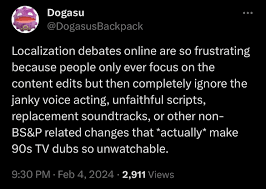
Reading Miracles reminded me of the English dubbed version of the anime Love Hina. In it, the character of Kitsune, voiced by Barbara Goodson, has a southern US accent. It’s jarring, to say the least, to hear that in a show that’s set in Japan. I happened to have the chance, 20-plus years ago, to ask ADR director Wendee Lee why that choice was made, and she told me it’s because Kitsune comes from a rural area where people speak similarly to how Americans in the south speak.
In Miracles, several of the characters speak in a way that is more colloquial to American (or, at least, English-speaking) audiences. There are instances of “gonna”, “kinda”, “wanna”, and the like. This is clearly a choice made by the translator, Sam Bett. My guess is that he’s trying to communicate the characters’ backgrounds through their dialogue, but, as with Love Hina, it’s… well, it’s not jarring per se, but it’s distracting.
Authors of course can make their characters from wherever they want, so long as it makes sense to the story. I’m sure that, if I was reading this book in the original Japanese, I would understand better as to why Bett made the choices he did. However, as a mostly-monolingual individual (I speak a very limited amount of Spanish), I’m stuck reading only in the language I speak most fluently. I just have to deal with it.
Not all translators localize, though. The translator for the first three Dragon Tattoo books, Reg Keeland, chose not to localize the English translation. It made the books a little dry in places, because Keeland had to explain things that English-speaking audiences might not know, especially if they didn’t know much about Sweden, Swedish politics, or Swedish culture, but I actually preferred it that way.
I do wonder if any of my books will ever be translated, and, if so, what kinds of localization will be done by the translator. It’ll probably never happen, so it’s not something I have to worry about, but I’m curious nonetheless.
 JJ Rose, Author