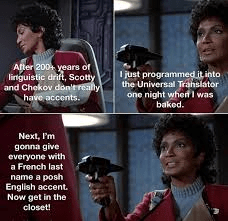
Linguistic drift is the way language changes over time. It’s fascinating. Even in the past twenty-five years we’ve had some of it — the change of the meaning of “literally”, for one thing. So when sci-fi writers write stories that take place in the far future, they have a tendency to make use of this.
One example is in a short-story that I wrote that takes place in the year 2800 or so. The MC’s daughter says her dad is doing something “very red”, because red is the color of bad things happening on a spaceship, which is where they live. (I’ve since changed the color code as part of revisions.) It leads me into what I want to talk about today.
I recently finished reading The Mimicking of Known Successes, a cozy far-future post-apocalyptic mystery by Malka Older. Overall the book was quite enjoyable, if a little slavish to its Holmesian main character’s mannerisms. I felt that the better we got to know Mossa the more — for lack of a better word — autistic her behaviors became. But that’s not important right now.
Mimicking takes place a few hundred years in the future, and there’s been some linguistic drift. Specifically for the swear words. One is “radiation” — which makes sense, I suppose, if you’re in a spacefaring society where radiation is a bad thing to encounter. It’s like saying “that’s shitty” because poop is generally considered to be a bad or gross thing. Unfortunately it was conspicuous to me by its usage; while the author I’m sure was trying to convey details of the setting and time period, it just pulled me out of the story more than a classic swear word might do.
She did the same thing with the word “conservative”, which is apparently so bad that one character said something to the effect of “when he called you… the c-word.” It actually took me a moment to have to think about what was meant by that sentence; it was presented as a terrible thing to call someone when it happened, but so terrible that you can’t even say the word in conversation when not directing it at someone? It’s meant, I think, to draw parallels to the n-word in how bad it is to call someone that, but really it was just distracting because I had to figure out what the c-word was.
A lot of authors utilize this kind of linguistic drift when writing their stories. Even I do on occasion. But it’s important to remember that, even if you want your characters to be different (or alien), sometimes it’s better to stick to something a little more standard so your reader doesn’t have to think too hard and take themselves out of the story you’re telling. I mean, the author got this book published and it was nominated for a ton of awards, so clearly she’s doing something right, but to me this was not an optimal writing choice. Still: good book.
 JJ Rose, Author