I’ve talked in the past about how I get frustrated when writers overuse words. I’ve also talked about how I prefer to use actions instead of dialogue tags. Unfortunately, sometimes it becomes too much even for me.
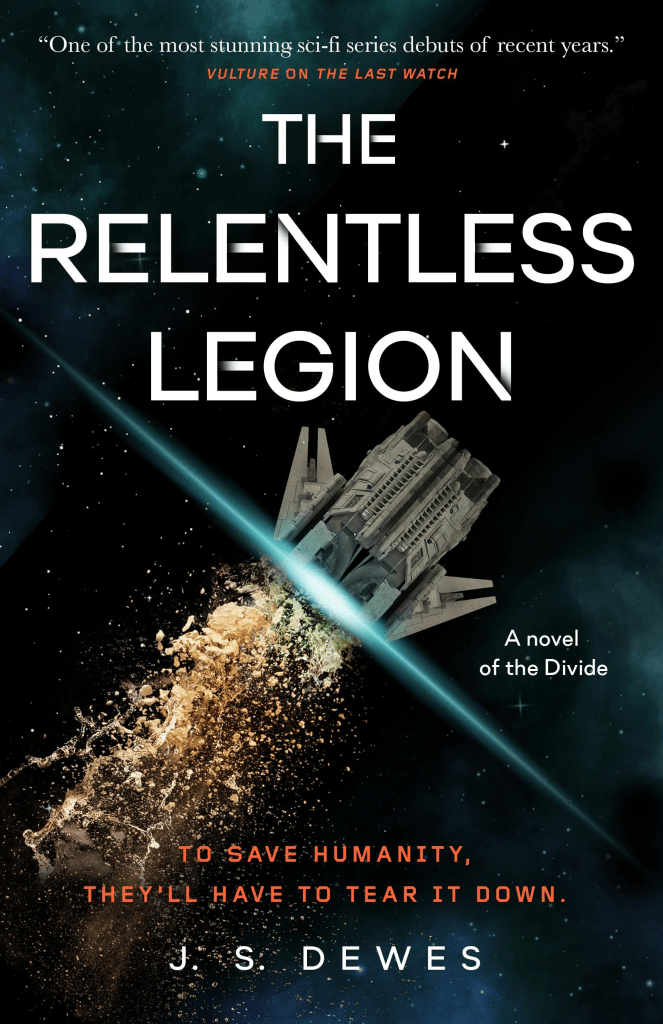
I recently finished reading The Relentless Legion, the third book in JS Dewes’s “The Divide” series. I came across a few issues.
The first issue is totally with me, and not with the author, but it’s been so long since I read the second book that I forgot almost everything that happened in it. Contrast that to what I’m reading now, Onyx Storm — it’s only been a few months since I read the first two books, so I remember more about what happened in them and I’m a little better-situated to enjoy Onyx Storm. It took about three or four chapters of The Relentless Legion to get back into the swing of things.
The second issue is another word-overuse one. The author way overused words that had double Fs in them — scoffed, chuffed, etc. — when describing dialogue or noises people made. They’re certainly evocative, and I completely understand why the author is using them, but to my eye at least they were overused. I know I’m not a saint when it comes to overusing words myself, but when you have a publisher and editor it’s the editor’s job to pick up on these things.
The third issue is the hardest one for me to pin down, because it’s something that I actually encourage writers to do: use actions instead of dialogue tags. But somehow it felt like the author was overdoing it. I can’t quite explain it, except to note that she did do something I particularly dislike, something that many authors do:
Verbing the noun, she verbed the direct object.
A more concrete and obvious example (not drawn from the book in question):
Running her hand through her hair, she reviewed the data on the enemy fleet.
It makes the sentence more about the first action than the second. I might write it this way:
She reviewed the data on the enemy fleet, and ran her hand through her hair roughly as she realized there was no hope of survival.
I admit it: my way isn’t necessarily better. I’m sure that, in time, I could come up with a better way to say the sentence, but usually when I face this issue I rewrite the entire paragraph, and sometimes even the paragraphs before and after it, so that it feels more natural. This does occasionally lead to more wordiness, but that’s what editing is for — write the book, rewrite the book, edit the book, edit it again.
I will say that I quite enjoyed The Relentless Legion — the ending was mostly satisfying, even though there was a detour in the middle that didn’t quite work for me. I recommend “The Divide” as a series of books to read; check them out if you like sci-fi.
 JJ Rose, Author