Generally, authors don’t like to write in the third-person omniscient point of view. Jumping around from head to head like that can get a little confusing, and — at least in my estimation — it’s easier to move from POV to POV by putting a space between them. But some authors are actually good at it, to the point that you don’t really notice.
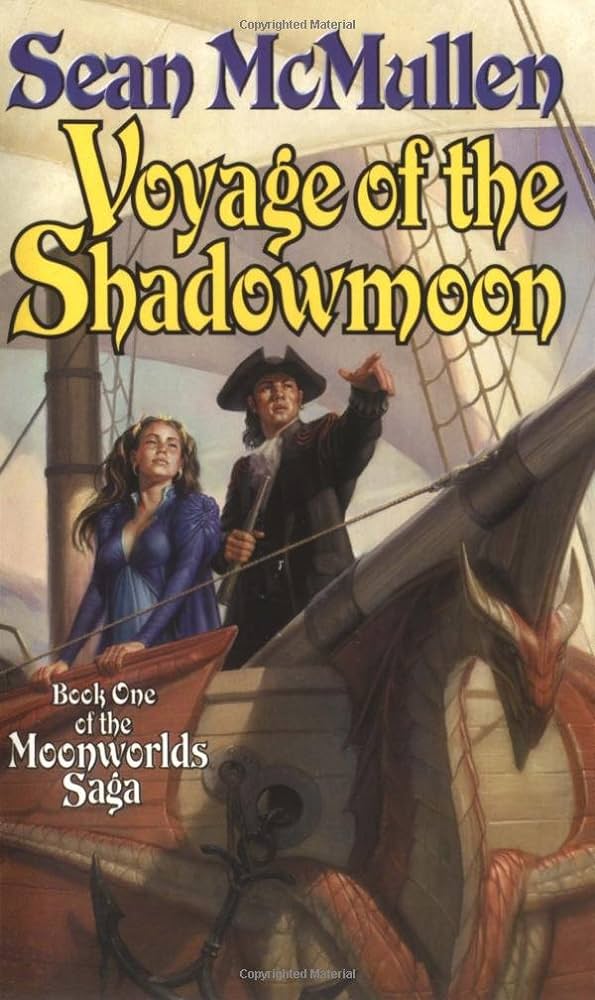
I recently reread Sean McMullen’s Voyage of the Shadowmoon, a fantasy novel about various parties trying to take control of a superweapon that can destroy entire continents. It took me a few pages to realize that the author — who is one of my favorites — was writing in third-person omniscient. I paused at that point to consider if the book might be better had he instead used spaces between the POVs, and decided that it would not. The downfall of putting spaces in between POV shifts is that you break up the text, and if you’re only going to spend a moment with a character — especially a very minor one — it can be jarring.
That said, jarring can be good. In the novelization of the movie Gremlins, there’s a chapter with two words in it: “Pete forgot.” A lot of impact was made by having a blank page with just that small message on it. Similarly, if you’re jumping POVs with spaces, you can use the spacing to your advantage; in my first ever Buffy the Vampire Slayer fanfic story, I wrote it in third-person limited but used spaces to swap viewpoints, and during one of the climactic scenes I wrote a single line of text, offset by spacing, to show the impact that a particular character death was having on another character.
Third-person limited is the closest I get to omniscient these days — although when I’m writing choose-your-own-adventure stories I go with second-person limited. For my style of writing it just doesn’t work. But for Shadowmoon, it does.
Unfortunately, the cover… doesn’t. To be fair, it’s a hard book to encapsulate in a single cover image, but if I saw this on the shelf I might not buy it today. Not because I think it wouldn’t be good, but because the cover doesn’t draw me in. Of course, this book was published over a decade ago, and tastes have changed. I honestly don’t know why I bought this book when I did; maybe it was recommended to me, or maybe I picked it up anyway and read the back cover copy. Whatever the reason, I’m glad I read it, and all these years later it still holds up as clever, well-plotted, and often amusing.
Just goes to show what you can do with an omniscient viewpoint.
 JJ Rose, Author